
Built $500K in the S&P 500? Should I Also Own a Rental Property?
Have $500K in the S&P 500 and RSUs? See a 20-year model of keeping two-thirds in stocks and adding a rental: returns, downturns, taxes, and trade-offs.
THE ONE-BASKET PROBLEM
If you've saved $500K and most of it sits in the S&P 500 and your company's stock, you've done a lot right. You've also quietly tied your salary, your unvested RSUs, and your savings to the same economy, the same sector, and often the same employer.
I know this position well because I was in it. My career, my vesting stock, and my index funds all moved together. A bad year for tech would hit my paycheck, my equity, and my portfolio at once.
In a previous blog post, I compared the S&P 500 and a rental property head to head. This post asks a more practical question: what happens if you keep two-thirds in the market and move about a third into a long-term rental you own?
WHY NOT JUST BUY MORE INDEX FUNDS?
An S&P 500 fund is already highly diversified across hundreds of companies. But buying more of it adds more public-equity exposure, which may not solve the concentration you're trying to reduce when your salary and RSUs are already tied to the same market.
A rental property earns its return in different ways:
Rent comes from a tenant's need for housing, not from your employer's stock price.
Leverage lets $140K control a $500K asset, with the tenant paying down the loan.
A fixed-rate mortgage stays flat while rent and property value rise with inflation.
It isn't marked to market daily, so a scary headline doesn't show up as a red number on your phone.
Real estate isn't immune to recessions. In 2008, stocks and home prices fell together. But its return drivers are different enough that owning both gives you more than one engine.
THE 67/33 SCENARIO: $500K OVER 20 YEARS
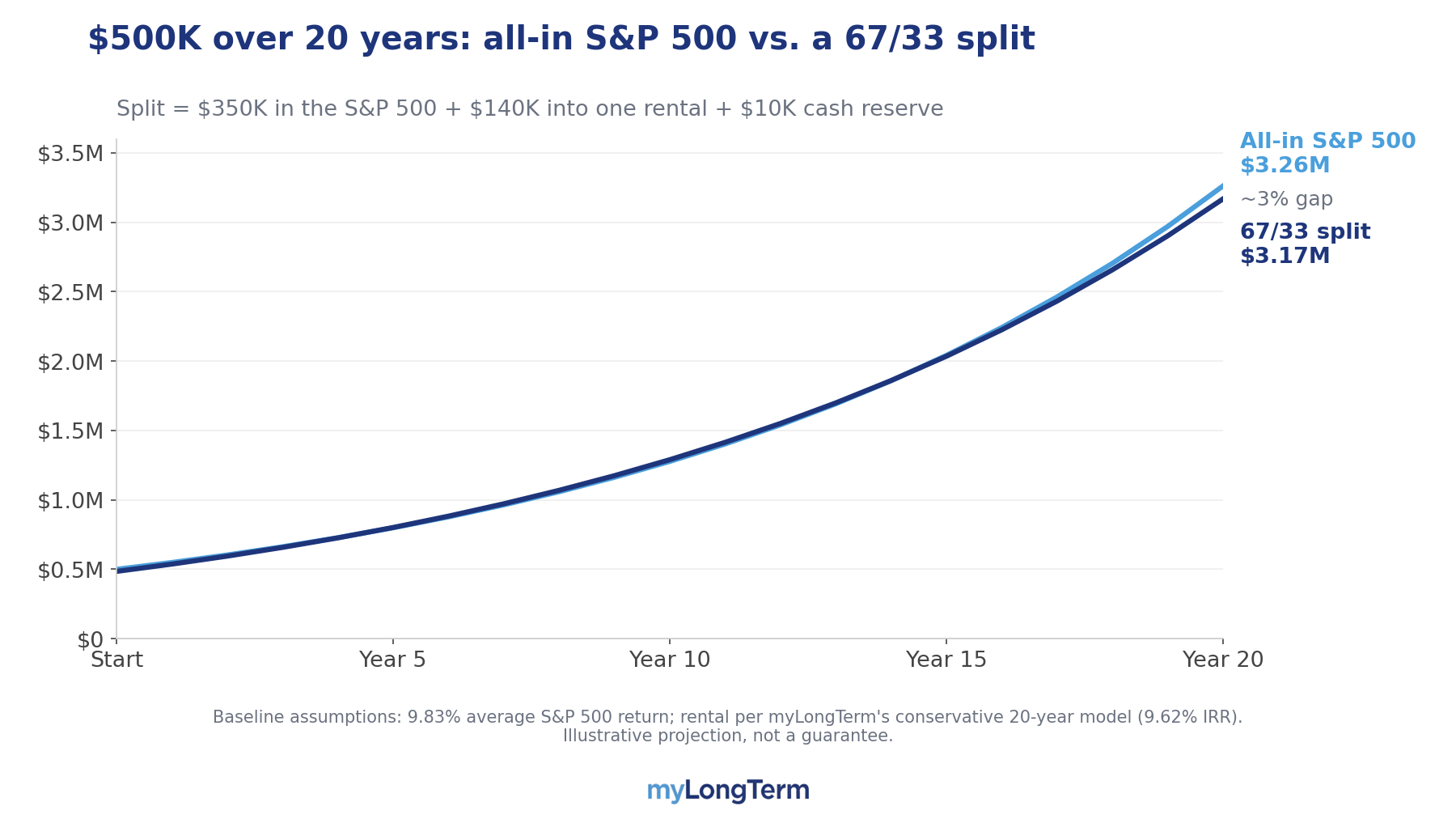
In an average market, the split portfolio ends about 3% behind going all-in on the S&P 500: roughly $3.17M versus $3.26M. What you get for that gap is two engines that behave very differently when markets move.
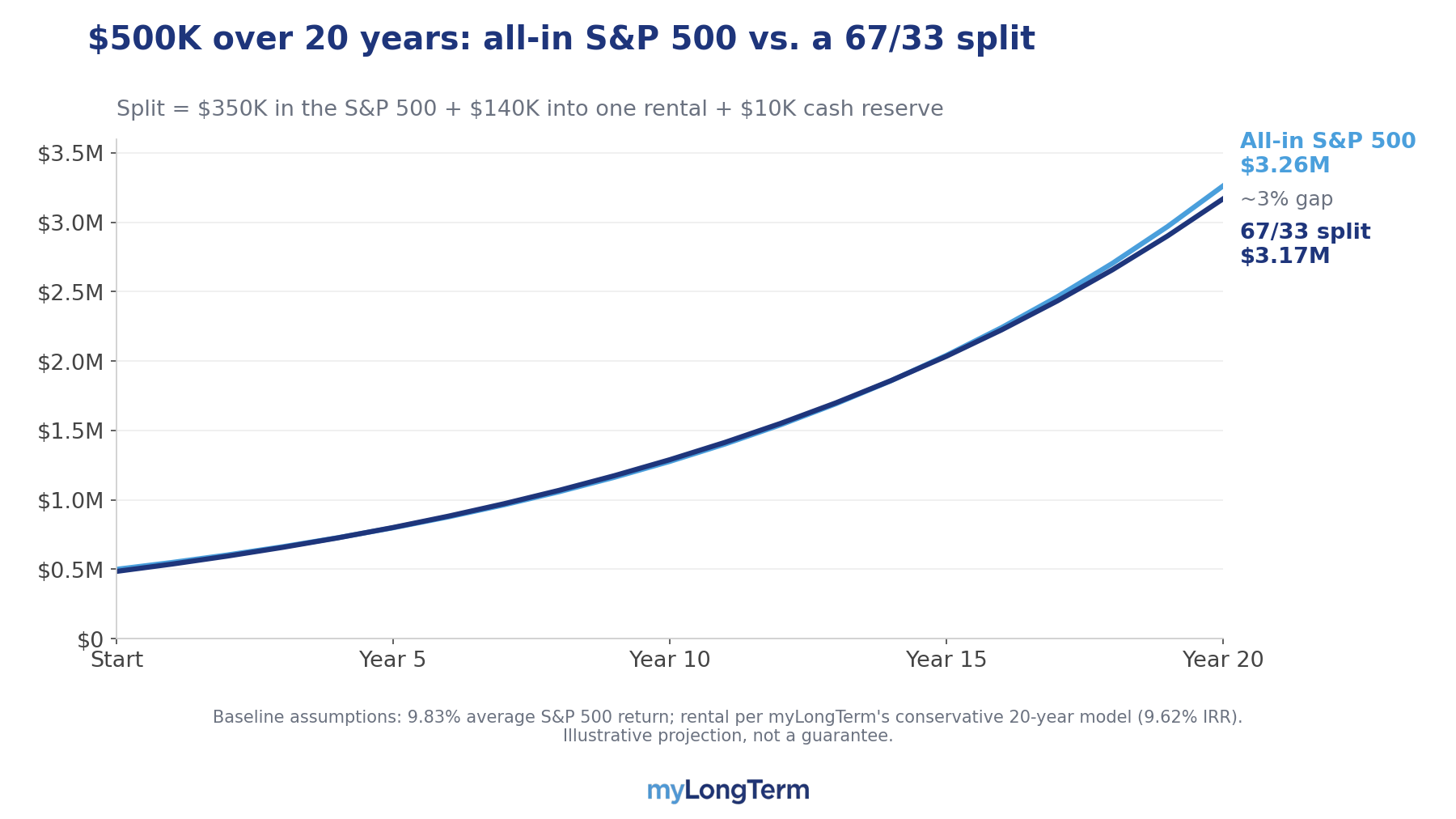
In the baseline model, the split ends about 3% behind, with two engines instead of one.
Here's the setup. You have $500K and compare two paths:
All-in: $500K stays in the S&P 500.
Split: $350K stays in the S&P 500. $140K buys the same $500K rental I modeled in a previous blog post (25% down plus closing and prep). The last $10K sits in a cash reserve at 3% to cover the first couple of years, because keeping liquidity for a rainy day is non-negotiable.
The math uses the same assumptions as that post: a 9.83% average S&P return, and the rental's baseline case (9.62% IRR, $868,985 total value after 20 years). That rental model is deliberately conservative. My clients are typically seeing vacancy closer to 2% than 6%, higher rents than I first estimated, and rates below 6.25%. Think of it as the base case to beat, not the expected result.
The $140K and the 67/33 split are just for illustration, not a recommended allocation. In practice, I've seen clients invest anywhere from $80K to $200K, depending on the property, financing, reserves, and their own goals.
WHAT YOU GIVE UP
Let's be clear about the price of diversifying. In the baseline, the split portfolio ends about 3% behind going all-in on the S&P 500. Here's what else you give up.
Liquidity. You can't sell a slice of a house. Keep enough outside the property for emergencies and job changes.
Some upside. That 3% gap in the baseline widens in strong stock markets.
Effort. Even with a property manager, you'll approve repairs, review statements, and make decisions a few times a year.
Single-asset risk. One property in one market is concentrated too. A bad tenant, a big repair, or a local slowdown hits harder than any single stock in an index fund would. Borrowing more against it later amplifies that risk too.
So what do you get in return? A second return engine, different tax treatment, leverage on a real asset, and a property that produces income. That trade shows up when markets move, in either direction.
WHEN MARKETS FALL: THE RENT KEEPS COMING
In a downturn, both your stocks and your property can lose value on paper. The difference is that your property may keep producing rental income even while its market value falls.
As I showed in Does Rent Always Go Up?, U.S. rent has risen year over year every single year since 1980, based on BLS data. Between Q1 2007 and Q1 2012, the average U.S. house price fell 19%. Over nearly the same period, national rent rose 11.6%.
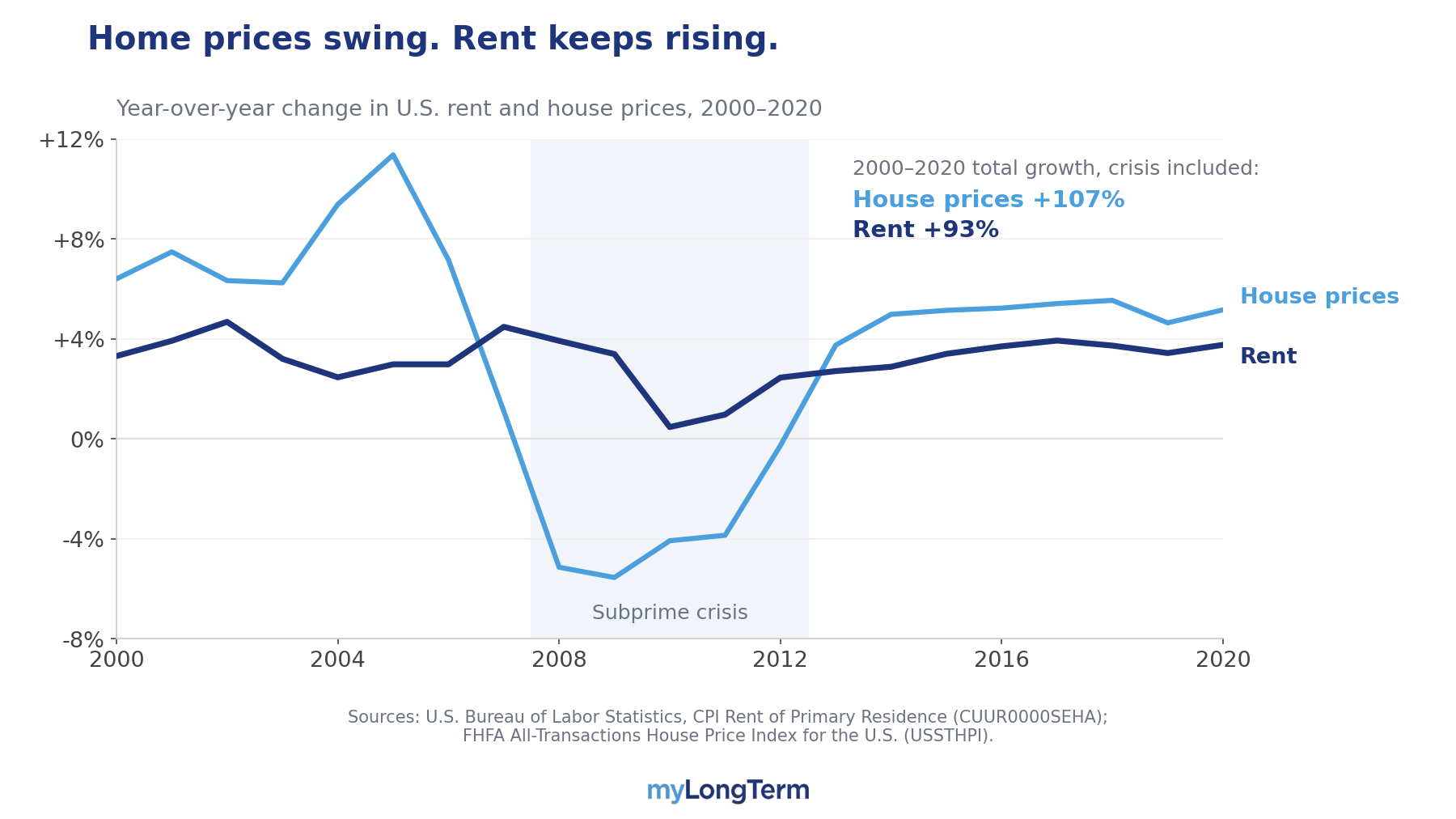
Even in the worst housing crash in decades, national rent never fell.
Stock income didn't hold up the same way. S&P 500 dividends per share fell about 21% in 2009, from $28.39 to $22.41, and didn't climb back above their 2008 level until 2012. To be fair, dividends grew quickly once the recovery took hold. But if you were counting on that income during the crisis, a fifth of it disappeared right when you needed it most.
That matters most for someone in tech. A downturn can hit your job, your RSUs, and your index funds at once. Your tenant's rent doesn't depend on any of them. As long as it keeps covering the mortgage, you aren't forced to sell anything at the bottom.
One caveat: these are national averages. Some markets fell much harder (Nevada dropped 55%), and a single property can still sit vacant. That's why market choice and reserves matter.
WHEN MARKETS RISE: SELL OR REFINANCE?
When stocks go up, realizing the gain usually means selling shares and potentially triggering capital gains tax. With a rental property, you have another option: borrowing against the equity through a cash-out refinance. Borrowed money isn't income, so there's no tax on it. You keep the property, the rent, and its future appreciation.
In the baseline model, by year 10 the house is worth about $718K and the loan is down to about $316K. That's about $400K of equity. A cash-out refinance at 75% of the home's value could put roughly $210K in your hands after costs, without selling the house or a single share of stock.
The caveats. A bigger loan means a bigger monthly payment, so your rental cash flow will be lower after a cash-out refinance. And while the cash itself is tax-free, the interest on the extra amount you borrow generally isn't deductible against your rental income unless you put that money back into the rental business, such as buying another property. That's a playbook for another post, and a good one to review with your CPA.
THE PASSIVE INCOME, HONESTLY
At today's rates, a financed rental can run slightly negative in its early years. Over time, the economics can improve, because the mortgage payment stays fixed while rents may rise.
You also have levers to speed it up. If rates fall enough, refinancing may improve the property's economics, after accounting for closing costs and the new loan terms. Or you can put a larger down payment in at the start and have positive cash flow from day one.
Keep a "rental bank account." I recommend setting aside some extra money in a dedicated account for the property, usually around $10K. That way a temporary negative month, a vacancy, or a surprise repair never forces you to sell anything. I check in with my clients after a couple of years to see whether it needs a top-up.
Once the loan is paid off, the property pays you over $4,000 a month in projected dollars, with no stock to sell.
TAXES: REAL ESTATE PLAYS BY DIFFERENT RULES
Depreciation can shelter some, or sometimes all, of a rental property's current cash flow from income tax. S&P dividends, by contrast, are taxed every year.
Dividends: taxed every year, whether you want income or not. Qualified dividends are taxed at long-term capital gains rates of 15% or 20%. High earners pay an extra 3.8% net investment income tax on top. You owe it even if every dividend is automatically reinvested.
Rent: sheltered by depreciation. If about $400K of the $500K price is the building, you can deduct roughly $14,500 a year for 27.5 years. In the baseline model, even in year 20 the rental's cash flow is about $8,800 a year. That's well below the depreciation deduction, so in this model the rent's taxable income would be zero. I go deeper on this in These Aren't Tax Tricks.
The fine print: recapture. Depreciation isn't forgiven, it's deferred. If you sell, the depreciation you claimed is taxed at up to 25%. You may be able to defer it, or under current law potentially eliminate it, through strategies such as refinancing instead of selling, a 1031 exchange into another property (which defers the tax), or holding the property until your heirs receive a step-up in basis (more on that below).
The passive loss rule. Depreciation shelters rental income, but for most high earners it won't shelter your salary. Once your modified adjusted gross income is above $150K, rental losses generally can't offset W-2 or RSU income. The losses aren't lost, though. They carry forward to offset future rental income and gains. Real estate professional status (often for a spouse) and some short-term rental setups are exceptions, but the rules are strict, so work through them with a CPA.
How you fund it matters. Selling long-held index funds to raise $140K can trigger a large capital gains bill. RSUs sold at vest usually have little or no gain, since they were already taxed as income when they vested.
That's exactly what I did. When I worked in tech, I didn't like that my savings were tied to the same company that paid my salary, so I sold my RSUs as soon as they vested and put the money into real estate. Did I miss out on some stock gains? Definitely. But owning real estate while working in tech gave me something the extra gains wouldn't have: confidence in my long-term plan, no matter what happened to my employer.
GENERATIONAL WEALTH: WHAT YOU LEAVE BEHIND
A rental property can eventually pass to your kids as an income-producing asset, and under current law the step-up in basis can largely erase its taxable gain.
In the baseline model, the $500K house is worth about $1.03M after 20 years. Under today's tax law, when heirs inherit it, the cost basis steps up to market value. The appreciation and the depreciation you claimed can be wiped out for tax purposes, instead of being taxed as gain and recapture.
Both stocks and real estate can receive a step-up under current law. What I like about passing down a rental is that the asset can arrive with an income stream attached. It can keep paying your heirs without anyone selling anything. Some families hold one for decades and pass down both the property and the habit of owning it.
HOW I CAN HELP IF THIS IS YOU
I built my own portfolio from the same starting point: a tech career, vesting stock, and a lot of it in one basket. I now help people in that spot buy their first long-term rental without having to learn every lesson the hard way.
If you work with me, we'll:
Run the model using your numbers, including different investment amounts and the reserve you'd want to maintain.
Pick a market that fits your goals, whether that's cash flow sooner or appreciation over time.
Find and evaluate specific properties against the same assumptions you saw here.
Set up financing, an LLC, and a property manager you can trust from a distance.
Disclaimer: I'm not a financial advisor, CPA, lawyer, or real estate agent. This post is for informational purposes only and isn't financial, tax, legal, or investment advice. Figures are illustrative projections based on the assumptions stated, not guarantees.
Want to talk through your situation?
If you're sitting on savings and vesting stock and wondering whether a rental belongs in your plan, I'm happy to think it through with you.
The intro call is free, 20 minutes, and there's no pitch. Just a conversation.
Or reach out directly: yossi@mylongterm.com | WhatsApp: +1 (650) 658-1010