
WHY REAL ESTATE - AND WHY START EARLY.
Your biggest advantage as a young professional isn't finding the perfect investment. It's time.
An asset you buy in your early 30s has decades to appreciate, generate rent, pay down debt, and compound before you ever need to depend on it.
Real estate isn't a get-rich-quick strategy. Quite the opposite. I like it because it rewards patience.
That's why I believe residential real estate can be such a powerful part of a long-term financial plan: buy a good asset, finance it responsibly, let someone else help pay down the mortgage, and give it time.
Below, I'll show you the data behind that belief.
THE NUMBERS
TWO ENGINES, WORKING TOGETHER
A long-term rental builds value through two engines working together:
Appreciation: U.S. home values have grown about 3.9% a year on average, across every 20-year window since 1980.
Rental Yield: Gross rent, before expenses, typically runs 5–8% of a home's value each year.
After expenses and financing, my own conservative model of a typical rental comes out around 9.6% a year over 20 years, in the same range as the S&P 500's long-run average, with a tangible asset you control and income that can keep coming in when markets drop.
How does this compare to the S&P 500 over 20 years? I ran the numbers: S&P 500 vs Rental Property - A Balanced 20-Year Strategy
THE POWER OF LEVERAGE
LEVERAGE: THE BANK HELPS YOU OWN A BIGGER ASSET.
Own More for Less: A $140K investment (25% down) controls a $500K asset.
Amplified Growth: You gain appreciation on the full $500K, not just your cash.
Cash Without Selling: Refinance to access equity without selling. Borrowed money isn't taxed, though it means a larger loan and payment.
A $140,000 investment becomes about $827,000 in home equity after 20 years.
And that's before counting the rental cash flow along the way.
Model assumes a $500K home, 25% down ($125K) plus $15K in closing and prep costs, a 30-year fixed mortgage at 6.25%, and 3.68% yearly appreciation (just under the 3.92% national 20-year average). Estimated home value after 20 years: ~$1.03M, with ~$203K left on the loan. These are projections, not guarantees. See the full model →
TAX ADVANTAGES
THE GOVERNMENT ACTUALLY WANTS YOU TO OWN RENTAL PROPERTY.
The US tax code offers real estate investors a set of tools that most people never use - not because they're complicated, but because nobody told them they existed.
Depreciation: Offset your rental income to lower your tax bill.
1031 Exchange: Swap properties to grow your portfolio while deferring taxes.
Legacy Wealth: Pass assets to heirs with a "stepped-up basis," potentially eliminating capital gains tax entirely.
I go deeper on this: These Aren't Tax Tricks - Just Powerful Tools Anyone Can Use
INFLATION HEDGE
THE BIGGEST COST STAYS FIXED. YOUR INCOME KEEPS GROWING.
Inflation erodes savings accounts and bond returns. For rental property owners, it does the opposite - it widens your margin where it matters most.
Fixed Mortgage: Your largest expense - your mortgage payment - is locked in for 30 years. No surprises.
Rising Rent: National U.S. rents have risen every year since 1980, according to BLS data, and have outpaced overall inflation over the long run. Local markets can dip in a downturn, which is one reason market choice matters.
The Real Margin: Yes, some costs like maintenance and insurance will rise over time. But the gap between your fixed mortgage and your growing rent is what builds wealth - and that gap tends to widen over time.
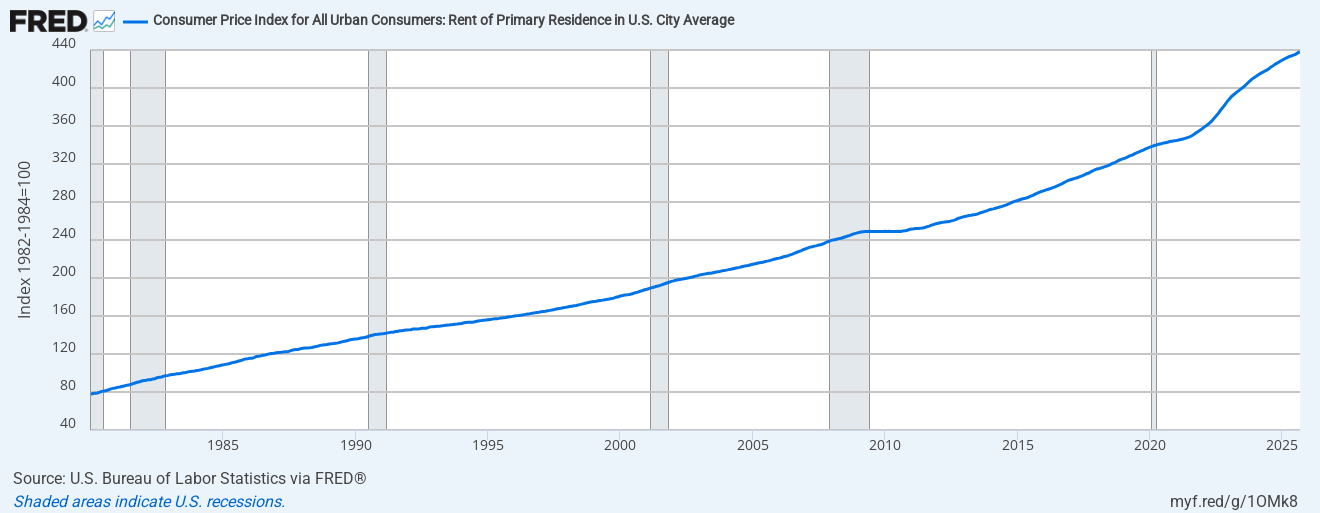
Consumer Price Index - Rent of Primary Residence in US (1980 - 2025)
Source: Federal Reserve Bank of Saint LouisDoes rent always go up? 45 years of data says yes: Does Rent Always Go Up? What 45 Years of Data Tells Us
THE HONEST PICTURE
REAL ESTATE ISN’T PERFECT. HERE’S WHAT TO KNOW GOING IN.
It requires expertise - knowing which market, which property, which numbers to trust. That's exactly what I help you learn.
It's not fully passive - at least not at first. But with the right systems and the right property manager, your active time shrinks to a handful of hours a year. I'll help you build that too.
It's less liquid than stocks - you can't sell it on a bad day when you need cash. But you can access your equity without selling through a refinance. And honestly? I think the illiquidity makes you a more disciplined long-term investor. It removes the temptation to react to short-term noise.
THE VERDICT
AMERICANS HAVE VOTED. REAL ESTATE WINS.
There’s a reason Americans consistently rank Real Estate as the #1 long-term investment (Gallup).
It's tangible, stable, income-generating, and resilient across decades of economic cycles.
References:
US Housing Sales Data: https://fred.stlouisfed.org/series/USSTHPI
US Housing Rent Data: https://fred.stlouisfed.org/series/CUUR0000SEHA#0
Gross Rental Return: https://www.nber.org/system/files/working_papers/w21804/w21804.pdf
Gallup Survey: https://news.gallup.com/poll/660161/stocks-fall-gold-rises-real-estate-best-investment.aspx
READY TO SEE WHAT THIS LOOKS LIKE FOR YOUR SITUATION?
The numbers on this page are historical averages and model projections. Your actual results depend on the market, the property, and the decisions you make. That's exactly what I help with.
See real case studies from Knoxville, TN and North Las Vegas, NV