
WHO PAYS YOUR ADVISOR?
HOW I DESIGNED myLongTerm AROUND TRUST
THE TRUST PROBLEM
Trust is one of the biggest reasons young professionals put off investing in real estate.
Some people feel they simply don't know enough. Some have heard horror stories about investors who made one honest mistake and paid for it for years. And many sense, correctly, that wherever this much money changes hands, it's not always obvious whose interests everyone at the table is representing.
That worry is reasonable. So when I designed myLongTerm, I started with one question: how do I make sure you never have to wonder whose side I'm on?
ONE RULE: I ONLY GET PAID BY MY CLIENTS
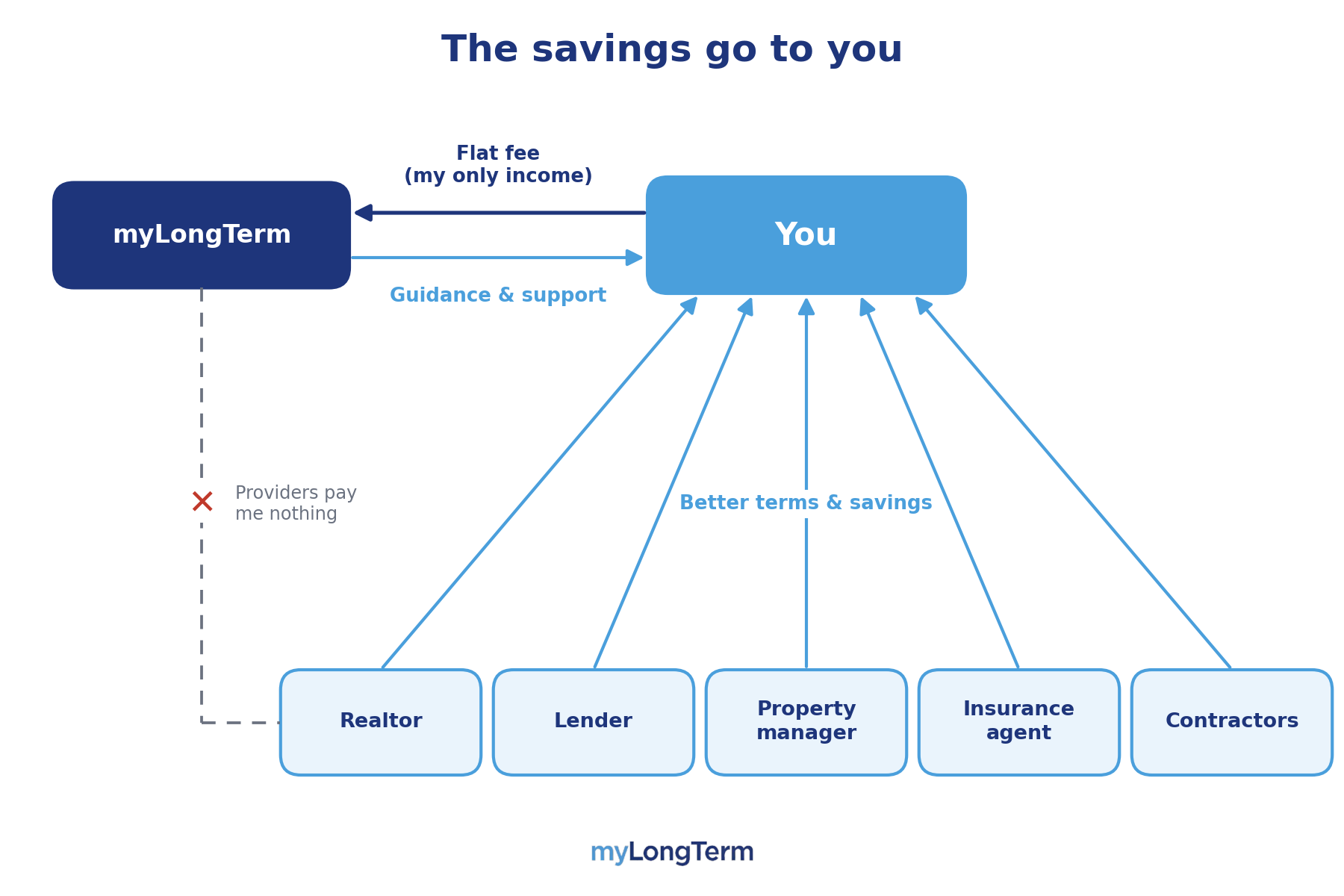
You pay me a flat fee. Realtors don't pay me. Lenders don't pay me. Property managers don't pay me. Contractors don't pay me.
Incentives matter. When an advisor earns more if you choose a certain lender, agent, or property, there's an incentive built into the recommendation, even when everyone involved is acting in good faith. With a flat fee paid only by you, that incentive simply isn't there.
WHY A FLAT FEE, NOT A PERCENTAGE
Many real estate service providers charge a percentage of the deal: a percentage of the purchase price, of the monthly rent, or of revenue above some threshold. I don't, and here's why.
A percentage rewards bigger checks. If I earned more when you bought a pricier property, took on a bigger loan, or pushed the rent higher, the fee structure itself would reward those decisions, even when a smaller, simpler deal is the better fit for you.
With a flat fee, my economics don't change based on what you decide. I can tell you what I would do with my own money, and explain why, without wondering whether one option pays me more than another.
What keeps my incentives aligned is simple: I do well when you do well. I'm happy when a client comes back for their next property, or refers a friend who's where they were a year ago. And honestly, I'm just as happy when a client tells me they're ready to do it alone. I truly believe people can do this themselves, the same way I do it for myself. If I've done my job well, you'll know enough to make that choice.
THE LESSON I LEARNED BUILDING TRUST AT EBAY

I led the trust team at eBay, and one lesson stuck with me: trust works best when you don't have to rely on everyone behaving perfectly. You design the system so people's incentives point in the right direction, and trust follows.
That's what I set out to do with myLongTerm.
WHAT HAPPENS WHEN SOMEONE OFFERS ME A REFERRAL FEE
The offers still come. Realtors, in particular, sometimes offer referral fees for the clients I bring them. I don't take them. Instead, where permitted, I ask the agent to structure it so the benefit stays with you, for example by reducing their commission. The exact structure depends on state law and your transaction, and it's always disclosed. And you're always free to choose a different agent.
No other provider pays me either: not lenders, not property managers, not insurance agents, not contractors.
THE NETWORK WORKS FOR YOU

That's the alignment half: I don't make money from your providers. Leverage is the other half. Because I bring repeat business to the same providers, I can often get you better economics and better service than you'd get on your own.
You still sign your own individual contract with each provider, and the relationship is yours, not mine. What changes is how you're treated. Providers know my referrals are educated clients who know what they want and are easy to work with (with a little help from me). They don't have to spend on marketing to find you, or spend hours explaining the basics. And a provider who lets you down doesn't just lose you. They risk losing everyone else I work with.
In practice:
Property managers offer better rates because of the number of doors I bring them, and I make sure you get those terms directly, as if you owned a whole portfolio yourself.
Lenders can sometimes offer my clients better terms. It helps that my clients are financially prepared, have their documents organized and ready to share, and come to lenders ready to move.
Insurance agents can't pay referral fees, and I wouldn't want them to. But the experience of everyone I work with helps me connect you with agents known for great service, fair prices, or both.
The goal: give an individual investor some of the pricing and service advantages of a much larger investor.
WHAT THAT CAN BE WORTH
Here's an example based on a $600K rental property renting for $3,000 a month, financed with 25% down ($450K loan).
| Where you save | How | Per year | Over 5 years |
|---|---|---|---|
| Closing costs | Reduced buyer-agent commission and lower rental-prep costs | $3,000–$5,000 once | $3,000–$5,000 |
| Interest rate | 0.25% lower rate on a $450K loan | ~$1,100 | ~$5,300 |
| Property management | 2–5% lower, counting monthly fees, leasing and renewal fees, and maintenance markups | $680–$1,710 | $3,400–$8,550 |
| Insurance | Shopping with trusted agents | $100–$200 | $500–$1,000 |
| Total estimated savings | ~$4,900–$8,000 in year one | ~$12,000–$20,000 |
None of these numbers is a guarantee. Each comes from real cases I've worked on, but your results will depend on your property, your loan, and your market.
The table also leaves things out: clients who negotiated a lower price or more seller-paid closing costs, lower maintenance costs from working with the right people, smoother rental transitions, and the time you don't spend finding and vetting providers. I've written separately about why longer, happier tenancies can be so valuable to a rental owner. For many clients, it all adds up to meaningful savings of money and time.
THE NETWORK GETS SMARTER WITH EVERY CLIENT
Sometimes a client runs into something that's new even to me: an HOA citing a rule nobody had enforced before, or an insurance premium that suddenly spikes at renewal. I learn from it, and the next client starts with that knowledge instead of discovering it the expensive way. Every client benefits from everyone who came before them, and helps make the path smoother for everyone who comes after.
Often the value is in much smaller things. When was the last time you had to remove a dead tree from a rental? Most people would have to figure out who to call, whether the quote is reasonable, and whether the contractor is properly insured. Chances are, I've already dealt with it.
COMMON QUESTIONS
Do I have to use the providers you recommend? No. My recommendations are just that. If you already have a lender, agent, or contractor you trust, I'm happy to work with them.
How do the realtor savings show up? Usually as a lower commission from the start or, where state law allows, as a credit at closing. Either way, it's shown on your closing documents and disclosed to your lender. Nothing happens off the books.
Are there limits on these savings? Yes. Lending rules and state laws can limit how credits, rebates, or commission reductions are structured, and the rules differ by loan type, such as a conventional loan versus a DSCR loan. That's why I don't promise a particular form of savings. I work with your agent, lender, and closing professionals to make sure the structure is permitted, documented, and fully disclosed.
So what exactly does my fee cover? One flat fee, paid only by you, in three installments: when we sign, when you close on your property, and when your first lease starts. It covers the whole journey, from strategy and choosing a market and property, through the purchase and rental prep, to your first year as a landlord. After that, we move to a light annual arrangement for as long as you find it useful.
LET’S TALK
If you've been holding back from real estate because you weren't sure who to trust, I understand. I built my service with that concern in mind. Book a free intro call, ask me anything, and see for yourself how it works.
You pay me. Providers don't. So when I recommend someone, you never have to wonder why. It's because they're right for you, and I'll always tell you what I would do in your shoes.
The intro call is free, relaxed, and takes about 20 minutes. If it's not the right fit, I'll tell you - and point you somewhere better.