
Owning your first rental is a big step. Most busy professionals I meet put it off for the same reason: they don't have the time, patience, or expertise to learn it all on their own.
That's where I come in. Working together, you avoid the rookie mistakes most first-time owners make, learn faster, and get things done more efficiently. It's still your property, your decisions, and your long-term value. You just get there with less guesswork, and come out of it knowing how to do it again.
There's also something most new investors don't realize: "doing it yourself" doesn't mean doing it alone. Either way, you'll work with the same kinds of professionals. The difference is how quickly you learn to work with them well, and whether they treat you like a pro.
THE MYTH: DIY MEANS DOING IT ALONE
Picture the most hands-on DIY investor you can imagine. They still don't underwrite their own mortgage or inspect their own foundation. To buy and rent out a single home, almost everyone works with:
A lender for the loan
A real estate agent to find and negotiate the home
An inspector to tell you what's wrong with it
An insurance agent to cover it
A property manager to find tenants and handle the day-to-day
Contractors for repairs before and after the first lease
A CPA for taxes, from the first year on
An attorney, when needed, for ownership structure or estate planning
If you're buying in another state, that list matters even more. You can't drive over to check on the work, so you depend on these people from day one.
So the choice isn't "do it myself" versus "have someone do it for me." It's about how fast you learn to work with them well.
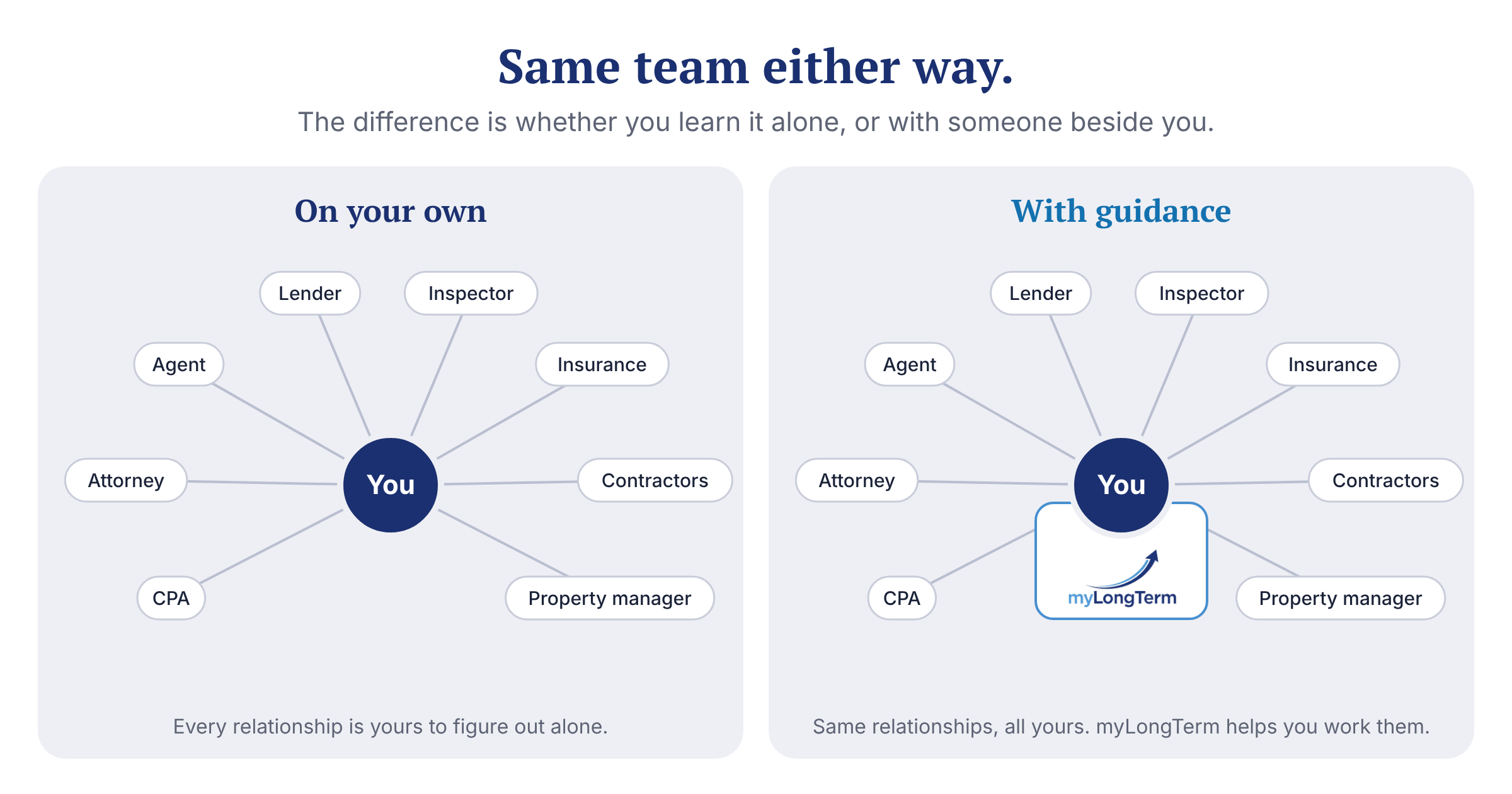
Same professionals either way. The difference is having someone beside you.
THE REAL DIFFERENCE: LEARNING ALONE, OR LEARNING FASTER
Think about how you handle any big, unfamiliar decision. When your kid starts at a new school, you call the parent who knows how things really work there. When you're dealing with the health system, you call the friend who's been through it and knows what to ask. They don't decide for you. They help you ask the right questions. A first rental works the same way. The question isn't whether you'll work with professionals. It's whether you figure it out alone, or with a friend who's done it many times.
Going DIY means learning all of it on your own: finding each professional, figuring out what to ask them, checking their work, and connecting the dots between them. When the inspector flags something, you decide whether it's a dealbreaker or a negotiating point. When the property manager suggests a rent, you decide whether it's right.
There's one more thing worth knowing. Almost everyone on that team gets paid when a deal happens. The agent earns a commission at closing. The lender earns on the loan. The property manager earns on the rent. They're not bad people, and many are excellent. But nobody on the team is paid to tell you "don't buy this one."
That's the gap I fill. You pay me a flat fee, and realtors, lenders, and property managers don't pay me anything. I introduce you to people I trust, help you prepare for every conversation, and tell you honestly what I'd do if it were my own property. Every contract is still directly between you and them, and every decision is still yours.
If anything, my job isn't to replace the professionals. It's to help you learn to work with them well, faster than you would alone.
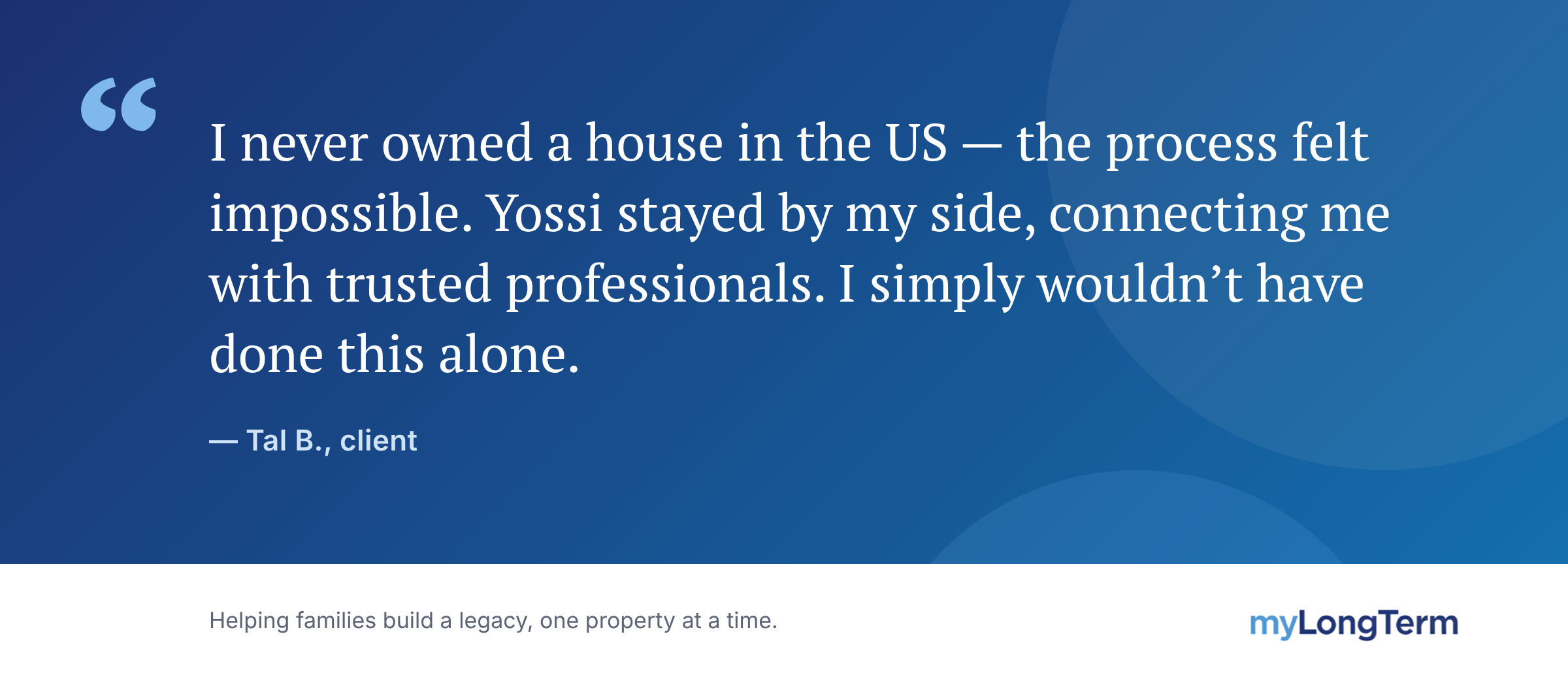
Tal bought her first US home from abroad, with guidance every step of the way.
WHAT GUIDANCE ACTUALLY GIVES YOU
The main reason to work with me isn't savings. It's having support when you don't have the time, patience, or expertise to do it all alone. In practice, that means fewer rookie mistakes and faster learning, more of your time back, and being treated like a pro. Money comes last, as a bonus.
1. Fewer rookie mistakes, faster learning
Most of what I know about owning rentals, I learned by paying for it. Working with me means you get that knowledge before it costs you.
A small example: the first time I had a dead tree removed at one of my rentals, it cost about $800. Years later, the same problem came up at another property, and the first quote was $2,000. I knew immediately that was too high, so I asked for another quote and saved about $1,000. A first-time owner has no way of knowing that. They'd probably just pay it.
That's what tribal knowledge looks like. It's not secret strategy. It's knowing what things should cost, which houses to stay away from, and when to push back.
It also compounds. Sometimes a client runs into something that's new even to me, like an HOA suddenly enforcing a rule nobody had enforced before, or an insurance premium spiking at renewal. I learn from it, and the next client starts with that knowledge instead of discovering it the expensive way.
2. Time
On your own, you start from zero: finding, interviewing, and vetting every professional on the list above, in a market you may never have visited. Working together, you start with people I've already worked with, and you choose from there.
Once you have a tenant, I can also be your property manager's first point of contact and help with bills, so your role is mostly decisions, not chores. And you're not the only one keeping an eye on how your providers perform.
3. Being treated like a pro
This is the one most new investors never think about.
Part of it comes from knowledge. Realtors, lenders, property managers, and contractors work differently with someone who knows what they're asking for. When you understand the process, you ask better questions, spot what's missing, and become the client everyone wants to work with. That stays with you for every home you buy after this one.
The other part comes from numbers.
When you own a single rental in another state, you're one small account to your property manager, maybe one of hundreds. If something isn't working, you don't have much leverage.
My own experience shows the difference. The property manager I used to work with in Tennessee charged a full month's rent for each new lease, 10% of rent every month, and half a month's rent at each renewal. They also added a 15% markup to every contractor they brought in. That last part mattered most: they earned more when repairs cost more, so their incentives pointed the wrong way. All in, it came to roughly 16.5% of my gross rent. And with more than 100 homes under management, my one or two houses were never their priority. The property manager I work with today, and introduce my clients to, charges a flat 7.5%, and the service is more personal.
On a home like my Knoxville rental, worth about $550,000 and renting for $2,850 a month, that difference is roughly $3,100 a year, every year you own it. These are my Tennessee numbers; rates and fee structures vary by market and by property, so treat them as an example, not a quote.
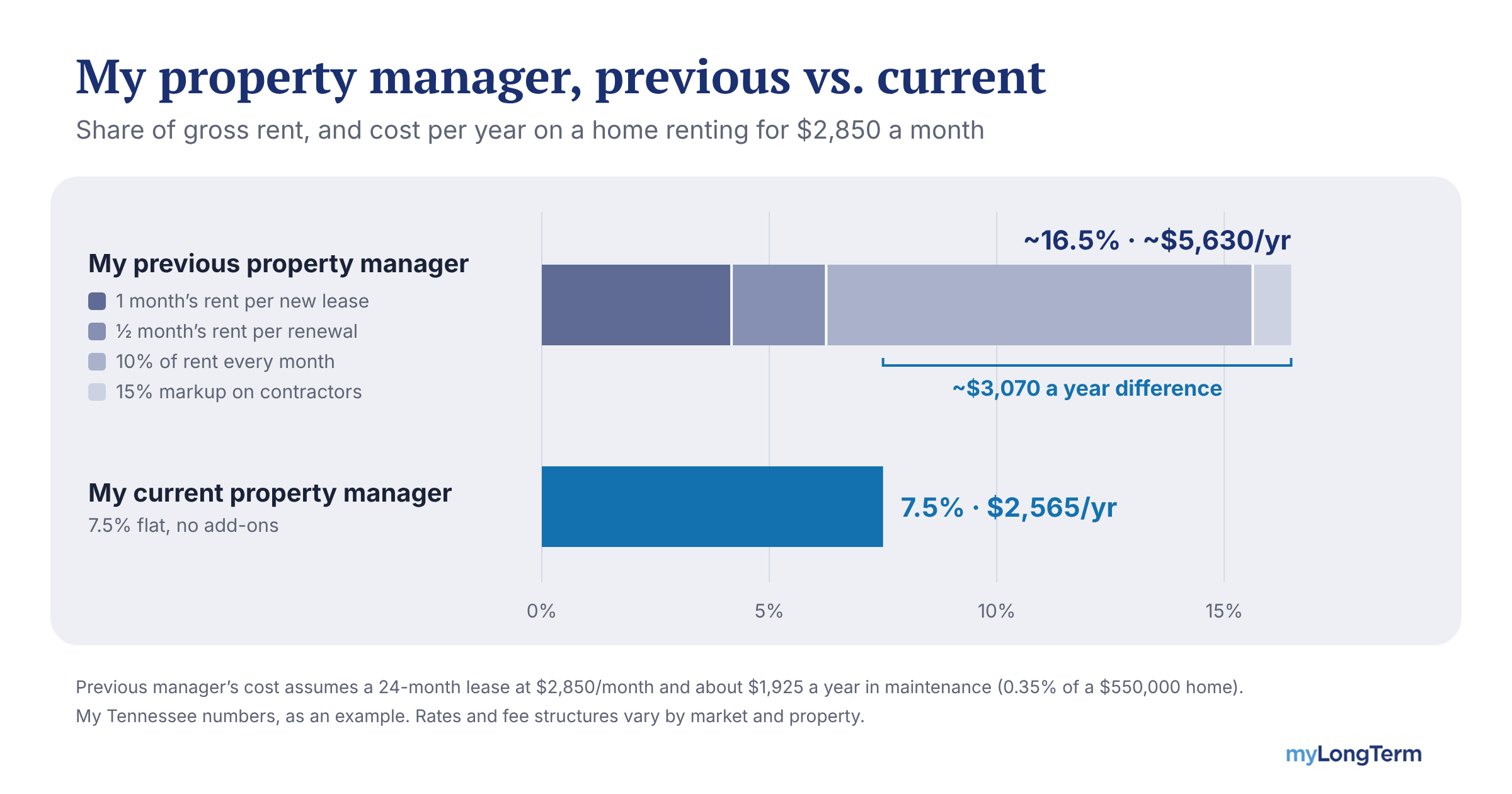
Same house, same rent. Switching managers saves about $3,000 a year.
To be fair, that's an extreme example. For most new investors, 12–14% all-in is a more typical range, so the illustration below uses the low end, 12%.
That's possible because several of my clients own in the same areas. The terms are available to every client directly, as if each of them owned a whole portfolio. And a provider who lets one client down doesn't just lose that client. They risk losing everyone else I work with. On your own, you're one deal. Together, you're part of a relationship they want to keep.
You're always free to pick a different provider. It's your call, and I'll help you compare.
4. And a bonus: it can pay for itself
None of this is the main reason to work with me, but it's a welcome side effect. It shows up in two places.
When you buy. Since no provider pays me, I can help you compare agents, lenders, and insurance honestly, and prepare for every negotiation. Where permitted, I ask realtors to pass any referral fee back to you, always disclosed. In Tennessee, that's been about $3,000–$3,750 on a $600,000 home. Some clients have negotiated $5,000 or more off the price. And a slightly better loan rate adds up: 0.125% on a $450,000 loan is about $13,000 over 30 years. None of it is guaranteed, but together it can add up to more than the setup fee.
Every year you own it. Here's an illustration for a $600,000 home renting for $3,000 a month:
| On your own | With guidance | Per year | |
|---|---|---|---|
| Property manager | 12% of rent collected | 7.5% of rent collected | ~$1,470 |
| Vacancy | 6% | 4% | ~$720 |
| Routine maintenance | 0.3%–0.5% of value | 20% less | ~$360–$600 |
| Total | ~$2,550–$2,790 |
That's more than the optional annual fee, before counting the hours you get back. Your numbers will depend on your market and home, so treat this as an illustration, not a promise. The full breakdown is on How I get paid.
WHAT STAYS THE SAME
Working with me changes how fast you learn, not who's in charge:
It's your property. Your name on the deed, your equity, your long-term value.
It's your decisions. I'll tell you what I'd do with my own property. You choose the home, the tenant, and every provider.
It's your relationships. I'm not your agent, lender, CPA, or attorney. Every contract is between you and them, and I help you work with them well.
Real estate still carries market risk. Markets move and homes need upkeep. My North Las Vegas case study shows how much a market can swing over a decade. Guidance helps you prepare for that, not wish it away.
It isn't for everyone, or everywhere. It's a flat fee, and I only work in a small number of areas I know deeply and own in myself. If you'd rather buy somewhere else, I'm not the right fit.
WHO SHOULD GO DIY, AND WHO MIGHT WANT HELP
DIY can be the right call if you:
Have a background in real estate, construction, lending, or finance
Have real time to spare for research, calls, and site visits
Are buying near where you live, in a market you already know
Already have trusted people for most of the roles above
Guidance tends to help most if you:
Don't have the time, patience, or expertise to learn it all alone
Are buying from a distance, in a market you don't know
Want to understand what you're doing, not just outsource it
Want to skip the rookie mistakes and be treated like an experienced owner from day one
It's not a one-time choice
I'll stay with you for as long as you find it useful. After the first year, some clients continue with a light annual arrangement. Others take what they've learned and go solo. Because every relationship and contract is already in their name, the handoff is clean, and going solo saves the annual fee as well. I'm just as happy when a client tells me they're ready to do it alone. If I've done my job well, they'll know enough to make that choice.
Some clients come back for a second home, and then a third, at a lower setup fee for each additional property. Each one builds on what they learned the first time and on the same trusted people. Over time, that can grow into a small portfolio, one you can keep running with my help or manage entirely on your own.
A QUICK SELF-CHECK
Answer honestly. If you say "no" to most of these, some guidance is probably worth it.
Could I name a lender, agent, inspector, and property manager I trust in the market I'm buying in?
Would I know if a repair quote or insurance premium was too high?
Can I tell a red-flag house from a real deal before I'm under contract?
Do I know what a fair property management fee looks like, and what to push back on?
Do I have the hours each week to research, compare, and follow up?
If something goes wrong 2,000 miles away, do I know who to call first?
THE BOTTOM LINE
DIY and guided aren't opposites. Either way, it's your property, your decisions, and the same kinds of professionals. The difference is whether you learn it all on your own, or with someone who helps you avoid rookie mistakes, learn faster, and get treated like a pro along the way. The savings can be real, but they're a bonus.
If you're curious which path fits you, the intro call is free, takes about 20 minutes, and comes with no pressure. If I'm not the right fit, I'll tell you, and point you somewhere better.
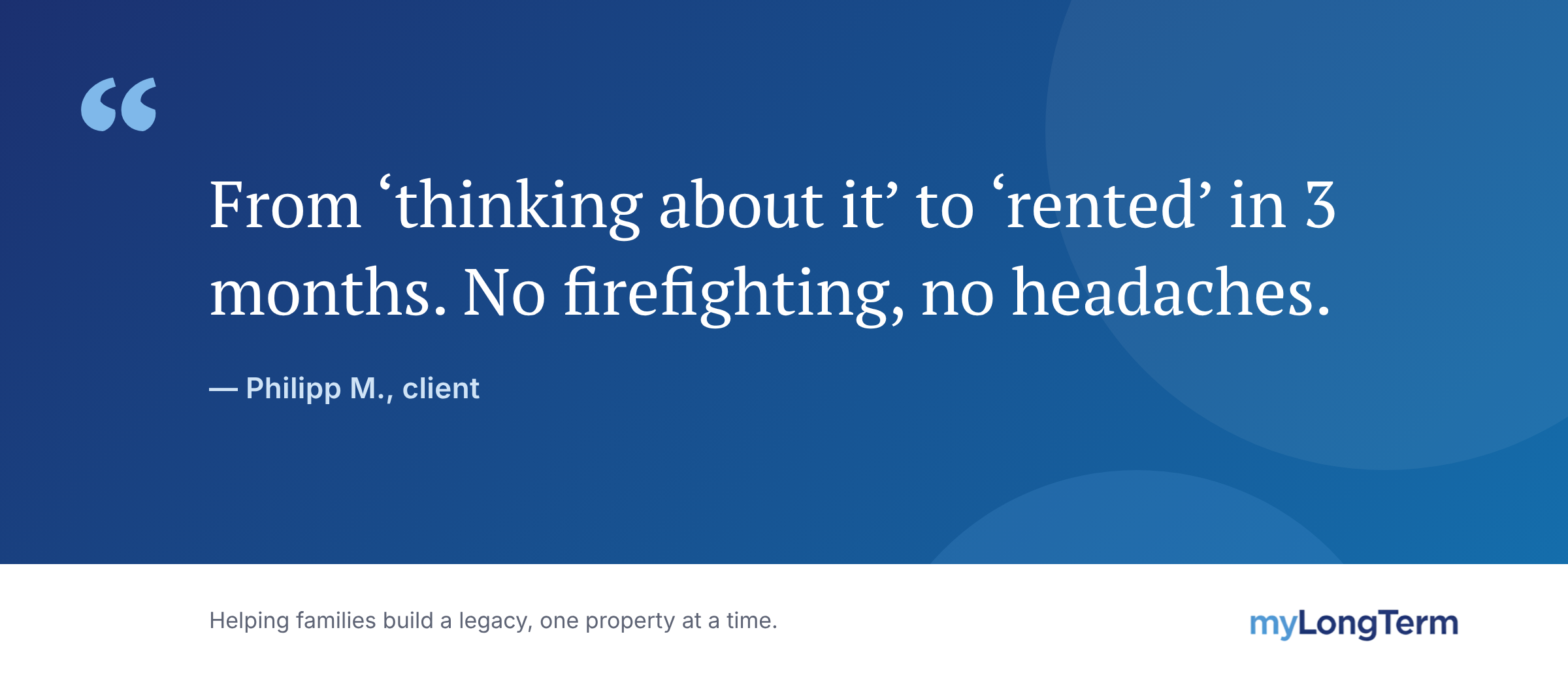
Philipp went from first call to a signed lease in three months.
